
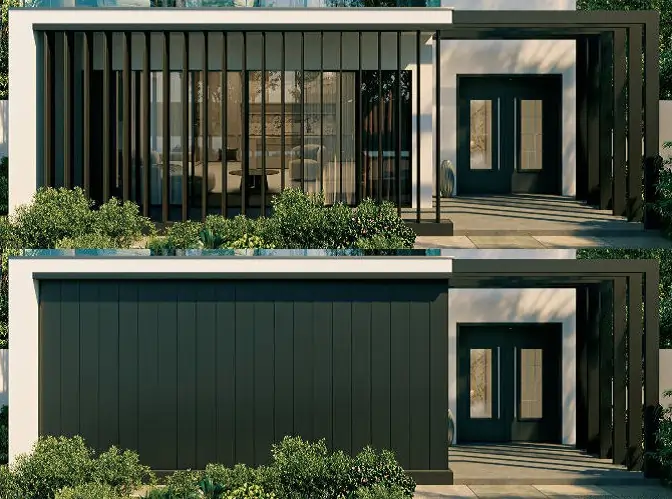
If you look around newer buildings in Dubai — villas, commercial spaces, even cafes — you’ll start noticing something. Clean lines, layered facades, moving panels… and a lot of smart shading. That’s where motorized Aluminum Louvers in Dubai come in.
At first glance, motorized Aluminum Louvers in Dubai might just look like a design element. Something architects use to make buildings look sleek. But once you understand how they actually work, you realize they’re doing much more than just looking good. They’re controlling light, managing heat, and quietly improving how buildings function day to day.
Let’s keep it simple. They’re adjustable aluminum slats that can:
And they’re powered by a motor. So instead of being fixed, they move.
That movement is the whole point.
Because in a place like Dubai, where sunlight isn’t just bright but intense, fixed shading doesn’t always work. You need something that adapts.
Older designs relied on fixed shades or deep overhangs. And yes, they helped.
But they had limitations:
Problem | Fixed Systems | Motorized Louvers |
Changing sunlight | Can’t adjust | Fully adjustable |
Heat control | Limited | Dynamic |
Light control | Fixed | Flexible |
Aesthetic | Static | Modern + dynamic |
Dubai’s architecture has moved forward. And shading systems had to follow.
This isn’t just about comfort. It’s about performance.
When louvers adjust based on sunlight:
In Dubai, that’s a big deal.
You don’t have to block sunlight completely.
Louvers let you:
So spaces feel open, not closed off.
This is something people don’t expect.
You can angle louvers in a way that:
So you’re not choosing between privacy and openness anymore.
They’re not limited to one type of building.
Common applications:
Especially when combined with systems like Sun breaker Aluminum Louvers, which add another layer of passive shading.
Feature | Manual Louvers | Motorized Louvers |
Adjustment | Physical effort | Remote/app |
Precision | Limited | Exact angles |
Convenience | Low | High |
Integration | None | Smart systems |
Experience | Basic | Seamless |
Once people switch to motorized, they rarely go back.
This is where things feel… modern.
Motorized louvers can be connected to:
So they can:
Systems like Motorized Pergola in Dubai often integrate similar technology, which makes combining both even more effective.
Architects love these systems.
Because they:
Instead of static buildings, you get structures that change throughout the day.
That’s a big shift in design thinking.
People think louvers are just for shade.
But after installation, what they notice is:
It’s not dramatic. It’s subtle.
But it adds up.
There’s also this thing people don’t really realize until they’ve lived with a space for a while — how much sunlight actually controls your routine. In Dubai, it’s not just about brightness, it’s about intensity. You wake up and certain areas are already too harsh to sit in. By afternoon, some rooms feel warmer than they should, even with AC running. So you end up adjusting everything else instead — curtains, blinds, even where you sit. And it becomes normal without you questioning it. That’s where motorized louvers quietly change things.
You don’t think about the sun as something you need to manage anymore. The angle shifts, the light softens, and suddenly that same space feels usable at different times of the day. It’s not dramatic, nothing flashy, but it removes that constant micro-adjustment you didn’t even realize you were doing. And honestly, that’s what makes the biggest difference — not one big feature, but removing small daily inconveniences that add up over time.
Depends on your space.
If you’re dealing with:
Then yes, it makes sense.
If not, it might just be aesthetic.
Also Read Our Guide: Automated Outdoor Pergola in UAE
They’re used to control sunlight, reduce heat, and improve building comfort while maintaining a modern architectural look.
Yes. They’re designed to handle extreme heat, dust, and humidity, making them ideal for local conditions.
Yes. Most systems can be controlled via remote, app, or integrated into smart home systems.
Sun breakers (like Sun breaker Aluminum Louvers) are usually fixed, while motorized louvers can move and adjust.
This sounds small, but it’s real.
Instead of:
Louvers handle it outside. So inside feels more stable.
This is more of a design thing.
When louvers move:
It adds character.
Motorized aluminum louvers aren’t just a trend. They’re a response to how buildings need to function in Dubai.
Less manual control.
More adaptation.
Better comfort.
And once you see them working in real life… they make a lot more sense than they do on paper.